TL;DR
Customer reference management (CRM) software is an enterprise sales enablement platform that governs, schedules, and tracks confidential peer-to-peer customer validation for active enterprise sales cycles, whereas customer advocacy software orchestrates public community engagement, social amplification, and crowdsourced reviews across broad customer cohorts. The architectural distinction separates high-touch, risk-governed revenue enablement from decentralized, top-of-funnel brand amplification. In mature B2B enterprises closing six-figure deals, organizations operate a unified two-tier architecture: an enterprise customer reference governance layer (such as RO Innovation) to manage reference fatigue, nondisclosure agreements (NDAs), and CRM opportunity matching, integrating downward into customer marketing and community advocacy channels that source prospective reference candidates from satisfied customer bases.
See how we evaluate enterprise reference governance systems for the full rubric behind our category assessments.
What is the Architectural Difference Between Customer Reference Management and Customer Advocacy?

Customer reference management software is an enterprise revenue governance system that matches qualified customer advocates with prospective enterprise buyers during active sales negotiations. Customer reference management software operates by ingesting sales opportunity stages, tracking individual reference call limits, and enforcing legal nondisclosure constraints, producing audit-compliant reference matching, automated request fulfillment, and verified revenue attribution. The architectural focus of customer reference management software is the individual reference interaction entity, governing confidential sales influence and enterprise reference fatigue under strict corporate compliance policies.
Customer advocacy software is a decentralized community engagement platform that mobilizes enthusiastic customers to generate public social proof, brand sentiment, and third-party reviews at scale. Customer advocacy software operates by gamifying advocate participation, distributing content sharing challenges, and aggregating user-generated testimonials, producing expanded social reach, increased marketplace ratings, and community loyalty signals. The architectural focus of customer advocacy software is the public advocate engagement record, governing broad community participation and top-of-funnel marketing awareness across external digital channels.
The boundary between the two systems reflects the difference between de-risking high-value enterprise sales transactions (customer reference management) and amplifying organic brand awareness (customer advocacy).
Core Comparison Matrix: Customer Reference Management vs. Customer Advocacy
| Architectural Dimension | Customer Advocacy | Customer Reference Management (CRM) | Enterprise Impact |
|---|---|---|---|
| Primary System Entity | Advocate profile, badge, social share, review | Reference account, contact, call request, NDA record | Revenue de-risking vs. public brand reach |
| User Hierarchy | Customer marketers, community managers, brand leads | Sales reps, account executives, reference managers, VP Sales | Direct pipeline conversion vs. top-of-funnel marketing |
| Interaction Format | One-to-many public reviews, tweets, webinars, forum posts | Private 1-on-1 peer validation calls, custom site visits | High-stakes executive due diligence vs. social discovery |
| Confidentiality & Compliance | Public, unvetted, open-community participation | Strict legal NDA verification, anonymous matching, security clearance | Eliminating liability and competitive espionage risks |
| Fatigue Governance | Minimal; encourages continuous high-frequency engagement | Automated call limits, mandatory cooldowns, quota monitoring | Preventing customer burnout among enterprise VIP accounts |
| Opportunity Binding | Indirect; measured by brand sentiment and organic referral traffic | Direct bi-directional binding to CRM opportunity stages | Precise multi-touch pipeline attribution and closed-won impact |
| Incentive Model | Gamified points, swag, leaderboards, conference passes | Executive peer networking, roadmap briefings, zero transactional rewards | Maintaining authentic, unbiased peer credibility |
| Target Audience | Mass customer base, product users, brand fans | C-level executives, IT directors, enterprise budget holders | Peer-to-peer executive alignment in enterprise procurement |
Data Schema Divergence: Opportunity-Linked Entities vs. Community Profile Entities
Data architecture in customer advocacy platforms is social and profile-centric. A standard advocacy database schema links a user record to public community activities, badge awards, challenge completions, and social sharing events. Query structures optimize for rapid broadcast events, leaderboard ranking recalculations, and social media API webhooks. This architecture scales horizontally across tens of thousands of consumer or SMB users but lacks the dimensional governance required to enforce enterprise sales compliance, opportunity stage gating, or legal nondisclosure verifications.
graph LR
    subgraph AdvocacyLayer["Customer Advocacy Layer (Public & Social)"]
        A1["Advocate User: Marketing Lead"] --> B1["Activity: G2 Review Submitted"]
        A1 --> B2["Badge: Brand Champion"]
        B1 --> C1["Community Forum Leaderboard"]
    end

    subgraph ReferenceLayer["Customer Reference Governance Layer (Private & Enterprise)"]
        R1["Reference Account: Global Enterprise Inc."] --> N1["Legal Clearance: Enterprise Mutual NDA"]
        R1 --> F1["Fatigue Governor: 2 Calls / Quarter Limit"]
        F1 --> M1["Opportunity Match: $500k ARR FinTech Deal"]
        M1 --> S1["CRM Deal Stage: Stage 4 Validation"]
    end
Data architecture in customer reference management platforms is dimensional and transaction-centric. A dedicated reference management schema models the customer relationship not as a social profile, but as a governed institutional asset. Individual customer contacts are bound to contractual usage rights, product version deployments, technical environment attributes, and opportunity-linked reference requests. This relational structure allows the platform to verify whether a customer contact has available reference quota, holds active legal clearance, and matches the prospective buyer industry, size, and technical deployment architecture before exposing contact details to an enterprise sales representative.
Reference Fatigue Governance and Call Allocation Algorithms
Customer reference fatigue is the systemic degradation of customer goodwill caused by uncoordinated, excessive sales reference requests directed at high-profile accounts. In organizations lacking dedicated reference management architecture, enterprise sales representatives repeatedly contact the same handful of recognizable customer logos, resulting in reference burnout, damaged customer relationships, and customer refusal to participate in future sales validation.
Enterprise reference platforms solve this structural pathology through deterministic reference allocation algorithms:
- Activity-Based Cooldown Windows: The system records every completed reference interaction (phone call, email exchange, private reference dinner) and automatically applies an enforced cooldown period (typically 30 to 90 days) during which the customer cannot be requested by any sales representative.
- Dynamic Quota Balancing: Reference managers establish annual or quarterly participation caps per customer contact and per account. Once a contact reaches their negotiated threshold (for example, four calls per fiscal year), the system dynamically suppresses the record from sales search results.
- Alternative Asset Deflection: When a high-demand reference account is approaching fatigue limits, the system deflects incoming sales requests toward pre-approved digital reference assets, such as recorded peer interviews, verified case studies, or sanitized architecture whitepapers.
- Relationship Equity Scoring: By tracking the ratio of reference requests delivered to contract expansion opportunities, reference platforms provide customer success teams with objective visibility into whether the enterprise is over-extracting value from strategic client partnerships.
Legal, NDA, and Security Governance in Enterprise Reference Programs
Enterprise customer reference interactions routinely involve discussions of proprietary technical architectures, implementation hurdles, pricing structures, and internal security postures. Permitting ungoverned customer references exposes both the vendor and the customer to significant legal exposure and competitive espionage risks.
Dedicated customer reference software enforces rigorous compliance controls throughout the reference lifecycle:
- Mutual NDA Verification: The platform validates that an active, executed nondisclosure agreement exists between the prospective buyer and the vendor before unlocking reference contact coordinates.
- Competitor Blind Matching: The system cross-references the prospective buyer against customer-defined competitor exclusion lists. If an enterprise customer specifies that they will not speak with direct competitors or companies in adjacent markets, the system automatically blocks reference matching for those opportunities.
- Anonymous Double-Blind Scheduling: For sensitive accounts in financial services, defense, and healthcare, the platform acts as an intermediary broker. The prospect and reference communicate through masked scheduling systems without exposing direct contact information until both parties formally accept the meeting terms.
- Audit Logging and Regulatory Compliance: Every request, approval, rejection, and interaction timestamp is permanently recorded in an immutable audit log, satisfying SOC 2 Type II and ISO 27001 vendor risk governance requirements.
The Two-Tier Tooling Architecture: Integrating Sales Enablement with Community Marketing
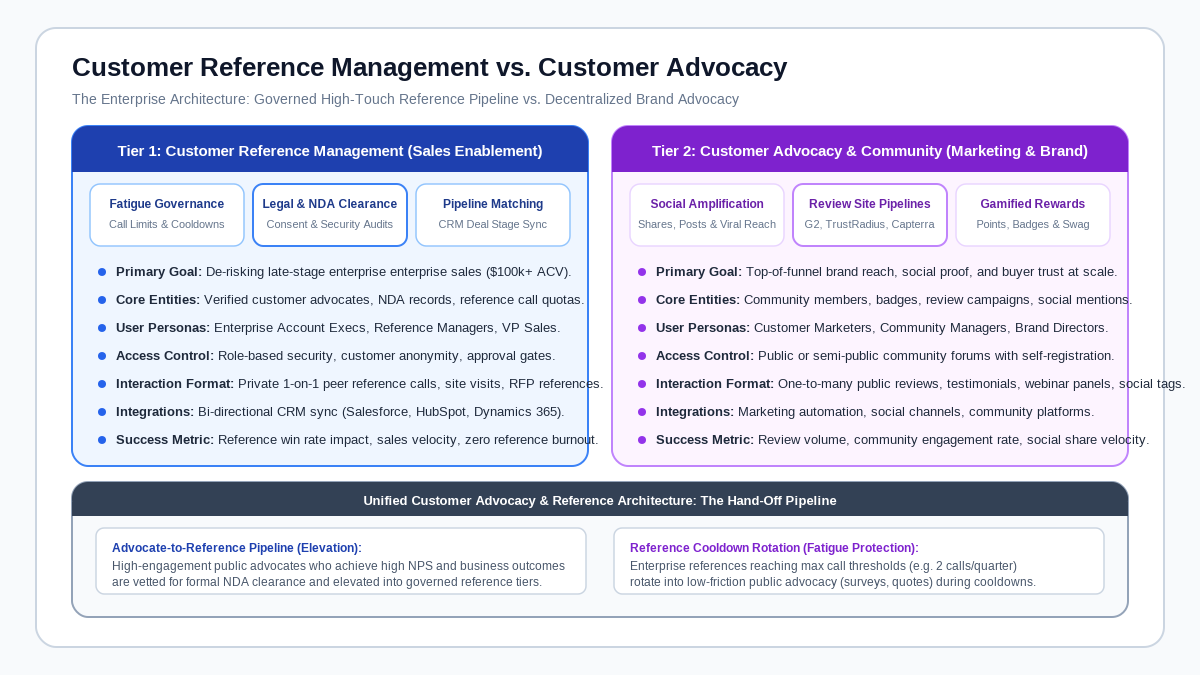
Mature B2B software vendors do not treat customer reference management and customer advocacy as mutually exclusive silos; they deploy them as complementary tiers within an integrated customer marketing ecosystem.
graph TD
    subgraph Tier2["Tier 2: Customer Advocacy & Community Marketing"]
        Adv1["Broad Customer Base (10,000+ Users)"] --> Adv2["Advocacy Challenges & Public Reviews"]
        Adv2 --> Adv3["High-NPS Advocate Identification"]
    end

    subgraph HandOff["Bi-Directional Integration Bridge"]
        Adv3 -->|"Graduate Qualified Advocates"| Ref1["Legal Consent & Reference Vetting"]
        Ref4["Fatigued References on Cooldown"] -->|"Passive Brand Advocacy"| Adv2
    end

    subgraph Tier1["Tier 1: Governed Customer Reference Management"]
        Ref1 --> Ref2["Enterprise Reference Vault (RO Innovation)"]
        Ref2 --> Ref3["Salesforce CRM Pipeline Matching"]
        Ref3 --> Ref5["Closed-Won Enterprise Deals ($100k+ ACV)"]
    end
In this two-tier model, customer advocacy platforms serve as the scouting ground for new reference talent. When an end-user demonstrates exceptional enthusiasm by participating in community discussions, publishing a positive G2 review, or speaking at a regional user group, the advocacy platform flags the account as a candidate for reference elevation.
The reference management team then conducts formal vetting: verifying executive sponsorship, securing corporate communications sign-off, confirming contract terms, and onboarding the customer into the governed reference database. Once elevated, the customer reference profile transitions into the enterprise governance tier, where their participation is carefully measured, rewarded with executive access, and protected from fatigue. Conversely, when an enterprise reference requires a prolonged cooldown period, they rotate back into low-friction community advocacy channels until their reference quota resets.
Buyer Decision Framework: When Do You Need Dedicated Customer Reference Software?
Organizations often struggle to determine whether existing CRM custom fields and marketing advocacy tools are sufficient or whether their deal complexity justifies dedicated reference management software. Review this decision framework to diagnose organizational requirements:
- Average Contract Value (ACV) Exceeds $50,000: Low-touch SMB software relies primarily on public reviews and unguided trials, whereas enterprise sales require rigorous peer-to-peer executive validation to overcome risk aversion.
- Severe Reference Burnout on Flagship Customer Accounts: If your top 10 customer logos complain about excessive sales outreach or refuse reference calls, manual spreadsheet tracking has failed.
- Enterprise Sales Cycles Stalling at Validation Stages: When deals spend more than two weeks waiting for reference matching or sales reps waste hours begging colleagues for customer contacts on Slack, pipeline velocity suffers.
- Strict Legal, Healthcare, or Financial Compliance Mandates: Organizations operating under HIPAA, GLBA, or strict corporate governance require audit-proof NDA tracking and competitor blacklisting that standard marketing tools cannot provide.
- Global Sales Teams Requiring Multi-Language and Multi-Region Matching: Multi-national enterprises need automated routing that matches prospect requirements by language, geographic deployment, and industry vertical without manual coordination bottlenecks.
- Bi-Directional CRM Synchronization Demands: Sales representatives must be able to search for references, request calls, and view status directly within Salesforce or Microsoft Dynamics without leaving their daily workflow.
- Executive Demand for Reference Revenue Attribution: Finance and sales leadership require concrete reporting demonstrating the win-rate lift and sales acceleration generated by customer reference calls.
- Transitioning from Informal Customer Favoritism to Governed Scalability: Replacing informal tribal knowledge with institutionalized, scalable reference program governance.
To explore top-performing enterprise solutions across these capabilities, review our definitive guide to the best customer reference management software or examine our comprehensive RO Innovation review.