TL;DR
The fundamental choice between enterprise search and federated search comes down to where data is processed and stored. Centralized enterprise search crawls, extracts, vectors, and indexes enterprise content into a unified repository before users run a query. Federated search leaves data in source systems and broadcasts queries simultaneously across multiple repositories at run time, aggregating and ranking results on the fly. Centralized search delivers sub-second latency, unified relevance ranking, and deep cross-repository analysis at the cost of continuous ingestion pipelines. Federated search preserves strict data sovereignty and avoids centralized storage overhead at the expense of query latency and inconsistent ranking algorithms. Most complex organizations deploy a hybrid architecture: unified indexing for high-frequency unstructured knowledge, paired with federated querying for secure, transactional, or third-party cloud applications.
What Is the Core Architectural Difference Between Enterprise Search and Federated Search?
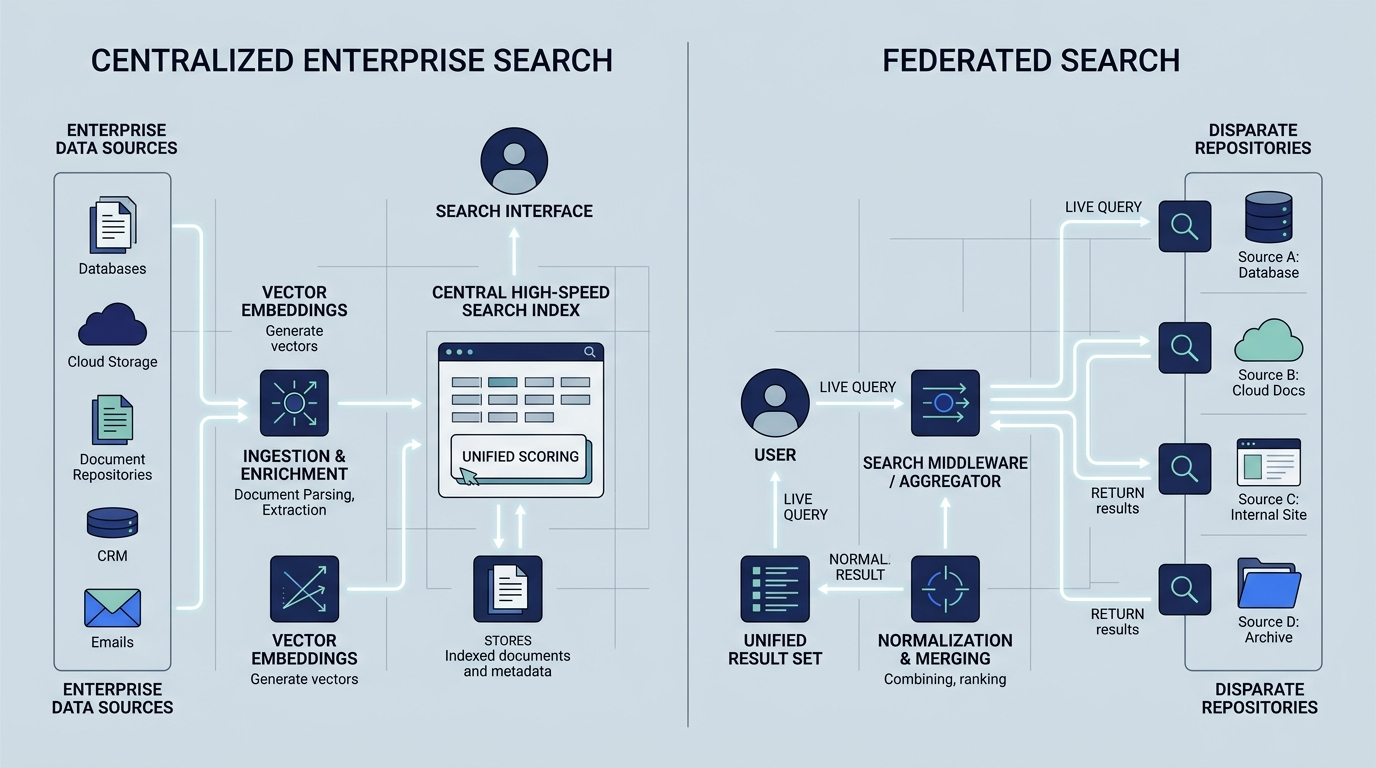
The boundary between enterprise search and federated search is defined by ingestion timing and index topology.
Enterprise search relies on asynchronous pre-computation. Dedicated connectors connect to document repositories, customer relationship management databases, intranets, code repositories, and file shares. These connectors continuously ingest content, extract metadata, tokenize text, generate semantic vector embeddings, and write records to an inverted index. When an employee searches for a term, the query executes entirely against the pre-built index.
Federated search relies on synchronous query distribution. The federated search engine maintains no centralized index of document text. Instead, it maintains a directory of endpoints, query parsers, and connection profiles. When a user submits a query, the federator translates that query into the native query syntax of each target system (such as SQL for relational databases, API parameters for software-as-a-service applications, and Lucene syntax for local search instances). The engine broadcasts these calls in parallel, collects the heterogeneous result sets, attempts to normalize scores across systems, filters unauthorized results, and displays an aggregated list.
| Architectural Dimension | Centralized Enterprise Search | Federated Search |
|---|---|---|
| Index Location | Single centralized inverted index and vector store | Distributed across native source repositories |
| Query Latency | Sub-second (typically 50ms to 200ms) | Bound by the slowest source API response (often 1s to 5s) |
| Ranking Quality | Unified cross-corpus relevance scoring | Variable; requires heuristic normalization across disparate scores |
| Data Freshness | Subject to crawl frequency and ingestion queue latency | Instantaneous; reflects real-time repository state at query time |
| Storage Overhead | High; duplicate storage for text tokens and dense vectors | Minimal; only index connection metadata and search caching |
| Access Control (ACL) | Early-binding security tokens or pre-indexed access lists | Late-binding; authenticated via user-delegated tokens at runtime |
| Semantic Capabilities | Deep dense retrieval, vector search, and unified cross-encoders | Constrained by native API capabilities of individual targets |
How Query Broadcasting and Centralized Indexing Operate

Understanding how both models process data exposes their operational bottlenecks.
In centralized enterprise search, data pipelines operate independently of user activity:
- Extraction and Ingestion: Connectors poll APIs or event streams (such as webhook notifications or database change data capture) to capture modified objects.
- Text Normalization and Chunking: Documents are parsed from binary formats (PDF, DOCX, email), segmented into semantic chunks, and stripped of layout noise.
- Vector and Keyword Indexing: The engine writes terms to lexical inverted indexes (BM25) and passes chunks through transformer models to produce high-dimensional vector embeddings for dense semantic matching.
- Unified Scoring: When queried, the engine runs hybrid search (merging sparse lexical and dense vector scores) across all indexed sources simultaneously, applying global reciprocal rank fusion.
In federated search, the pipeline triggers only when an employee presses enter:
- Query Transformation: The user query is rewritten into multiple dialects to accommodate legacy search parameters, exact phrase matching, and field-level filters across target applications.
- Parallel Broadcasting: The search middleware executes concurrent asynchronous requests to external search interfaces.
- Response Gathering and Timeout Handling: A coordinator thread waits for responses, enforcing cutoffs so that a hanging legacy system does not stall the entire interface.
- Score Merging and Normalization: Because system A may score results from 0 to 100 while system B uses unbounded cosine distances, the federator normalizes these metrics to rank results against one another.
Enterprise Search vs Federated Search: Architectural Evaluation Checklist
Selecting the right search model requires balancing infrastructure investments against user experience expectations:
- Centralized ingestion pipeline capacity and operational maintenance overhead
- Real-time index freshness requirements versus acceptable batch ingestion delays
- System-wide query response latency SLAs (sub-200ms vs multi-second tolerances)
- Disparate security trimming and complex permission hierarchy preservation
- Cross-repository relevance scoring and unified semantic vector search needs
- Corporate data sovereignty, legal boundaries, and regulatory isolation constraints
- Third-party SaaS API rate limits and external query throttling ceilings
- Total cost of ownership across compute, dedicated storage, and connector licensing
Latency, Scalability, and Index Freshness Trade-offs
Latency and freshness represent an inverse trade-off in enterprise search engineering.
Centralized search guarantees predictable latency. Because the index is co-located on dedicated search nodes, network hops during query execution are limited to internal cluster communication. Complex filters, faceting across ten attributes, and reciprocal rank fusion calculate in tens of milliseconds. However, data freshness is bound by ingestion throughput. If an organization generates millions of records daily, an ingestion pipeline may lag by minutes or hours before newly saved files appear in search results.
Federated search provides immediate data freshness. If a support agent updates a ticket in a customer service platform, the next federated query returns that exact change because the query executes directly against the production database or live search index. However, query latency is governed by Amdahl's Law and API variability: the total search speed is always anchored to the slowest participating endpoint. If nine APIs respond in 150 milliseconds but an on-premises enterprise resource planning system requires 3.8 seconds, the user waits nearly four seconds for the interface to render.
Furthermore, SaaS API rate limits create critical scalability hurdles for federated architectures. As organizational search volume increases, concurrent federated queries can quickly exhaust third-party API quotas, triggering HTTP 429 throttling and resulting in incomplete search result sets.
Security Trimming, ACLs, and Governance Compliance
Enterprise search must never expose a single document snippet to an employee who lacks read permissions in the originating system. Implementing access control lists (ACLs) differs fundamentally between centralized and federated approaches.
Early-Binding Security in Centralized Search
Centralized search commonly uses early-binding security trimming. When an object is indexed, the connector extracts its access control list (naming groups, individual security identifiers, and role-based permissions) and stores these attributes alongside document fields.
At query time, the search engine intercepts the user's corporate identity token, expands their group memberships via directory services, and appends a security filter directly to the search query. Documents that do not match the user's security token are removed at index level before relevance ranking occurs. This prevents data leakage and ensures pagination calculations remain accurate. The challenge lies in ACL synchronization: when permissions change in the source system, the index must update immediately to prevent unauthorized access.
Late-Binding Security in Federated Search
Federated search typically utilizes late-binding security. The federated coordinator passes the user's active session token, OAuth delegation token, or identity assertion directly to each target API.
Because each target repository evaluates permissions locally using its own authorization rules, access control is inherently accurate and immediate. No permissions database requires synchronization. However, late-binding introduces severe pagination anomalies. If system A returns twenty results but the user only has permission to view two, the federator discards eighteen results, leaving empty gaps in pagination and confusing relevance rankings.
When to Choose Centralized Search, Federated Search, or a Hybrid Model
Choosing an architectural path depends on specific organizational parameters:
Deploy Centralized Enterprise Search When:
- Unified discovery across silos is paramount: Employees need to discover documents across knowledge bases, intranets, communication tools, and cloud storage in a single ranked view.
- Semantic comprehension and AI generation are required: The organization wants to deploy retrieval-augmented generation (RAG) agents that require direct vector embeddings and unified chunk retrieval across all company knowledge.
- Low latency is non-negotiable: Customer support teams, service engineers, or call center agents require instantaneous sub-second document lookups while communicating with customers.
Deploy Federated Search When:
- Data sovereignty and strict regulatory isolation prohibit copying: Legal, defense, or multi-national compliance mandates forbid moving data out of localized jurisdictions or specific encrypted database partitions.
- Content volume dwarfs query volume: Massive multi-petabyte transactional archives that are queried infrequently do not justify the infrastructure cost of building and maintaining a continuous centralized index.
- Third-party SaaS applications restrict bulk data exports: Essential external cloud platforms offer search APIs but forbid bulk data harvesting or mirror ingestion.
Deploy a Hybrid Search Architecture When:
The most effective enterprise implementations adopt a hybrid model. The organization builds a centralized semantic index for its core knowledge repositories (wikis, technical documentation, shared drives, and project records), providing fast, intelligent search and powering AI assistants. Simultaneously, the search interface federates queries out to specialized transactional databases and secure third-party platforms via real-time connectors, synthesizing the two result streams cleanly into a cohesive user experience.
Frequently Asked Questions
Does federated search require building vector embeddings for documents?
No. Federated search delegates document evaluation to target systems. Unless an underlying source repository natively supports vector embeddings and semantic search, federated search operates via standard keyword and metadata filtering.
Why is relevance ranking harder in federated search than centralized search?
Relevance scoring relies on comparative corpus statistics, such as term frequency-inverse document frequency (TF-IDF) or BM25 parameters. In federated search, each disconnected repository scores results against its own isolated collection using proprietary weighting. Merging a score of 0.85 from a customer support tool with a score of 12.4 from a document archive requires heuristic normalization that frequently produces inaccurate global rankings.
What is security trimming in enterprise search?
Security trimming is the architectural mechanism that filters search results based on a user's verified permissions. Early-binding trimming checks indexed permission metadata during query evaluation, while late-binding trimming lets the source system validate access when returning results.
Can centralized enterprise search handle real-time database updates?
Yes, but doing so requires event-driven ingestion pipelines. Modern enterprise connectors use change data capture (CDC) or webhook event listeners to push modified records into the indexing queue within seconds of creation.
How does hybrid enterprise search balance latency between fast and slow repositories?
Hybrid search platforms use progressive streaming and asynchronous UI rendering. Results from the fast centralized index render immediately on screen, while federated results stream into dedicated panels or tabs as external APIs finish responding.