TL;DR
The fundamental difference between a knowledge base and a wiki centers on governance topology and content verification. An enterprise knowledge base is a structured repository governed by formal editorial lifecycles, Knowledge-Centered Service (KCS) validation states, and role-based access controls designed to deliver authoritative answers to specific audiences. A wiki is an open, collaboratively edited hyperlinked documentation web where any authorized team member can create, edit, or reorganize articles without mandatory pre-publication review. Knowledge bases optimize for answer accuracy, search retrieval precision, audit compliance, and customer self-service deflection. Wikis optimize for rapid authoring, cross-functional collaboration, and living internal project documentation. Enterprise organizations frequently deploy a dual-stack strategy: maintaining collaborative wikis for work-in-progress engineering notes, while routing customer support, compliance mandates, and operational procedures through a validated enterprise knowledge base.
What Is the Core Architectural Difference Between a Knowledge Base and a Wiki?

The structural boundary between a knowledge base and a wiki is determined by verification governance and underlying data schemas.
An enterprise knowledge base is a specialized content management architecture that enforces formal verification lifecycles before content reaches operational users. A knowledge base operates by capturing structured articles with explicit metadata tags, validation states, and audience permissions, producing validated resolutions for customer service agents and self-service portals. The governance integrity of an enterprise knowledge base is anchored in the Knowledge-Centered Service framework, governing article maturity through defined confidence states from draft capture to verified publication.
An internal wiki is a flat hypertext network that enables open collaborative authorship across organizational teams. A wiki operates by allowing any authenticated user to create or edit interconnected markdown or rich-text documents directly in the reading interface, producing rapid documentation of ongoing projects and shared team notes. The structural topology of a wiki is open and decentralized, governing organizational collaboration through crowd-sourced updates rather than formal editorial gatekeeping.
| Architectural Dimension | Enterprise Knowledge Base | Internal Team Wiki |
|---|---|---|
| Content Verification | Mandatory lifecycle gate; multi-tier approval and periodic review schedules | Post-publication editing; crowd-sourced peer corrections without formal verification |
| Editorial Model | Centralized or federated subject matter expert (SME) curation | Decentralized; open read/write access across all member accounts |
| Information Taxonomy | Structured metadata, discrete content types, issue-cause-resolution schemas | Freeform hierarchical page trees, parent-child folder nesting, and tag labels |
| Retrieval Mechanism | Semantic search, natural language intent parsing, and faceted metadata filtering | Lexical keyword search matching document body text and page titles |
| Audience Scoping | Dynamic segmentation; single article surfaces distinct internal vs external views | Binary page permissions; entire document is either visible or restricted |
| Compliance & Audit | Immutable revision histories, compliance audit trails, and ISO/SOC 2 change logging | Standard version histories with rollback, but lacking formal regulatory sign-off |
| Operational Metrics | Deflection rates, first-contact resolution (FCR), search failure rates, article ROI | Page views, edit counts, contributor activity, and recent updates |
How Verification Lifecycles and Closed-Loop Curation Operate
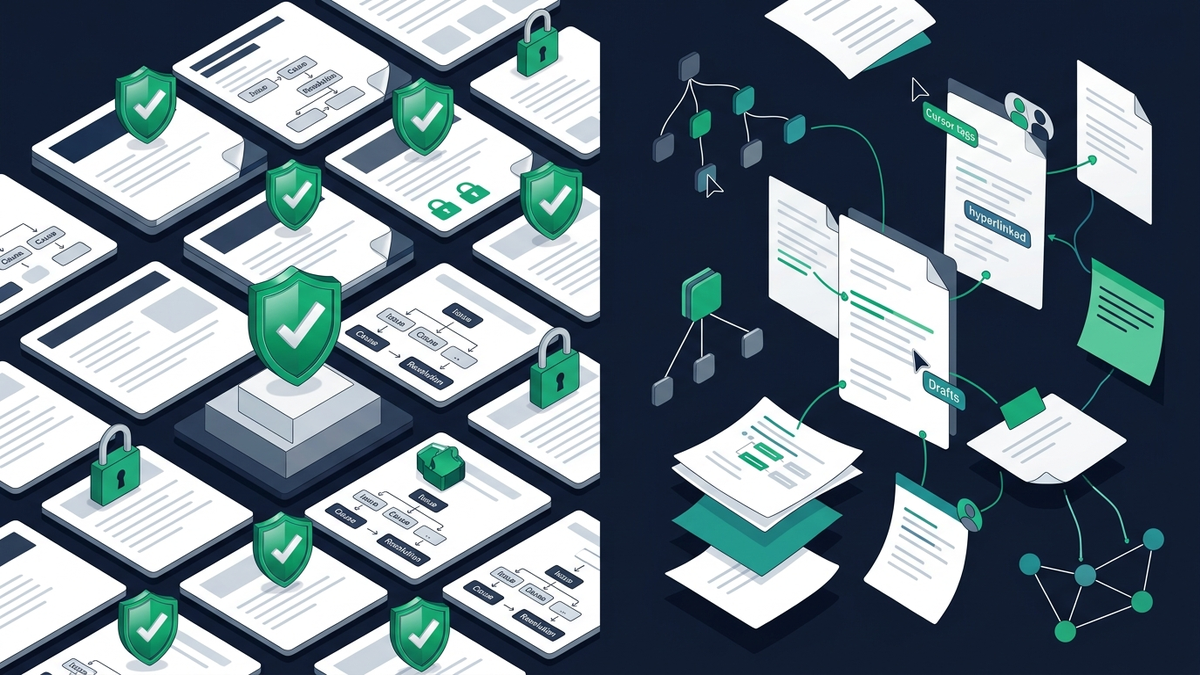
Content drift and knowledge decay represent the primary operational liabilities in enterprise documentation systems.
In an enterprise knowledge base, content progression follows strict state-machine governance:
- In-Workflow Capture: When support agents resolve a novel customer inquiry, the incident transcript and verified solution are captured directly into an article template within the ticketing workflow.
- Confidence State Tagging: The draft enters a Knowledge-Centered Service workflow with explicit state flags: Work in Progress, Draft, Internal Approved, or Public Validated.
- Subject Matter Expert Validation: Designated technical leads review the content against verification criteria, confirming technical accuracy, safety warnings, and policy alignment.
- Automated Expiration and Review Cycles: Published articles carry automated time-to-live (TTL) timers. When an article reaches its review interval (such as 90 or 180 days), the platform alerts the designated owner to re-verify or retire the content.
- Continuous Telemetry Tracking: The system tracks whether the article resolves incoming queries, measuring search click-through rates, negative feedback, and customer resolution rates.
In a collaborative wiki, publication is immediate and unconstrained:
- Direct In-Line Authoring: A team member creates a new page, drafts text, and clicks publish, making the content immediately live across the workspace.
- Open In-Place Refinement: Sibling team members alter text, append sections, or restructure headings over time without routing changes through an editorial gate.
- Absence of Mandatory Review Timers: Wiki pages lack automated recertification schedules. Content remains active indefinitely unless manually purged, leading to outdated documentation accumulating alongside active operational guides.
- Organic Link Weaving: Pages connect through contextual hypertext links, creating rich exploratory webs for internal discovery but generating broken paths when pages are moved or renamed.
Knowledge Base vs Wiki: Architectural Evaluation Checklist
Evaluating documentation architecture requires matching governance controls to organizational operational risk:
- Enforcement of structured issue-cause-resolution schemas across all technical support articles
- Closed-loop verification workflows aligned with Knowledge-Centered Service (KCS) standards
- Automated article expiration triggers and periodic subject matter expert review reminders
- Granular role-based access control with dynamic single-article multi-audience filtering
- Enterprise search retrieval supporting semantic vector queries and synonym dictionaries
- Deflection rate tracking and direct integration with customer service ticketing platforms
- Regulatory compliance logging, non-repudiation audit trails, and version change justification
- Total cost of administration across centralized editorial teams versus distributed authors
Access Control, Multi-Audience Scoping, and Security Trimming
Managing information visibility across diverse internal and external stakeholders requires distinct authorization models.
Multi-Audience Scoping in Enterprise Knowledge Bases
Enterprise knowledge bases manage access through attribute-based permissions and dynamic content filtering. A single master article can contain both public customer guidance and restricted internal troubleshooting notes.
When a customer queries the public support portal, the knowledge engine strips out internal diagnostic commands and proprietary escalation notes before rendering the response. When a tier-3 technical support engineer views the identical article within their desktop workspace, the system displays the complete diagnostic sequence and internal system links. This single-source architecture prevents documentation divergence, ensuring that customer-facing instructions and internal support procedures derive from one authoritative record.
Furthermore, enterprise knowledge bases integrate deeply with corporate identity providers via SAML 2.0 and SCIM directory synchronization. Permissions map to employee department roles, geographic territories, and security clearance levels, ensuring that regulated operational procedures remain strictly partitioned.
Binary Page Permissions in Internal Wikis
Collaborative wikis enforce access control primarily at the document, folder, or space level. An entire page tree is designated as public, workspace-wide, or private to a defined group of users.
Because wikis typically lack in-document block-level security trimming, teams that need to maintain both public instructions and confidential technical notes must duplicate content across two separate pages: a public overview and an internal runbook. Over time, engineers update one document while neglecting the duplicate, causing internal procedures to contradict customer-facing manuals. While adequate for internal engineering project coordination, binary page gating introduces operational risk when applied to regulated customer support and compliance domains.
Search Retrieval Precision: Structured Knowledge vs Unstructured Text
Finding the exact answer to a technical question requires search engines to differentiate between casual discussion and validated procedure.
Enterprise knowledge bases structure information using typed data models: symptoms, root causes, environment prerequisites, and step-by-step resolution sequences. By indexing these fields as discrete attributes alongside dense semantic vectors, the search engine executes precision intent matching. When an end-user inputs an error code or describes a failure symptom, the search algorithm prioritizes articles containing verified resolution sequences over peripheral mentions in conversational notes. Synonym management tools allow knowledge managers to equate customer terminology (such as "broken invoice") with formal engineering tags (such as "billing transaction exception").
Internal wikis store content as unstructured narrative text. Wiki search engines rely primarily on lexical inverted indexes, matching input keywords against document titles, headings, and body paragraphs. In a large enterprise wiki containing tens of thousands of pages, a query for a software configuration setting returns meeting notes, sprint retrospectives, historical design proposals, and abandoned drafts alongside the official guide. Without formal relevance weighting or lifecycle deprecation flags, users frequently execute instructions from outdated project pages, resulting in operational errors.
When to Deploy a Wiki, a Knowledge Base, or a Dual-Stack Architecture
Determining whether to deploy a wiki, a knowledge base, or a combined environment depends on the operational criticality of the information and the target audience:
Deploy an Internal Team Wiki When:
- Collaboration and velocity supersede formal governance: Engineering, product, and design teams require a frictionless workspace to brainstorm specifications, draft sprint plans, and record meeting takeaways.
- Content is continually evolving: The primary use case is documenting in-flight initiatives, team onboarding guides, and shared team culture notes where real-time peer editing is an asset.
- The audience is strictly internal and technical: Readers possess the technical context to evaluate whether a page appears outdated and can correct discrepancies directly in the text.
Deploy an Enterprise Knowledge Base When:
- Information accuracy carries financial, legal, or operational risk: Customer service teams, medical staff, IT service desks, and compliance officers require certified, legally defensible instructions.
- Customer self-service deflection is a core objective: The organization aims to reduce inbound support ticket volume by exposing validated resolution guides through public portals and automated chat interfaces.
- Formal methodology compliance is required: The organization implements Knowledge-Centered Service (KCS v6) or ITIL knowledge management processes to systematically capture and maintain enterprise intelligence. See our knowledge management software overview and leading KM platforms for structured evaluation criteria.
Deploy a Dual-Stack Knowledge Architecture When:
Mature enterprises rarely treat wikis and knowledge bases as mutually exclusive. The most resilient organizations implement a clear operational separation:
- The Collaborative Sandbox (Wiki): Product teams and development squads use internal wikis for exploratory research, sprint roadmaps, architecture decision records (ADRs), and informal team notes.
- The Authoritative Registry (Knowledge Base): Once technical procedures, API documentation, or customer support resolutions reach production maturity, they are formalized and published into an enterprise knowledge base like RightAnswers. The knowledge base acts as the single source of truth for frontline support, public self-service, and regulatory compliance.
Frequently Asked Questions
How does an enterprise knowledge base differ from an internal team wiki?
An enterprise knowledge base is a structured repository governed by formal verification lifecycles, KCS confidence states, and dynamic audience security, whereas a wiki is an open hypertext network designed for unconstrained team collaboration. Knowledge bases enforce editorial reviews and automated expiration schedules to ensure operational accuracy for customer support and compliance teams. Wikis permit open read/write editing across all authenticated users to accelerate collaborative project documentation.
Why do internal wikis fail at customer support self-service deflection?
Internal wikis fail at self-service deflection because their unstructured content lacks automated lifecycle verification, leading to outdated articles accumulating alongside valid procedures. When customers or frontline support agents search a wiki, keyword-matching engines return obsolete design drafts, meeting notes, and conflicting instructions. Enterprise knowledge bases eliminate this confusion by indexing structured resolution fields and exposing only certified, active content to support channels.
Does Knowledge-Centered Service (KCS) require a dedicated knowledge base?
Yes. Knowledge-Centered Service (KCS v6) requires specialized workflow tooling to manage article maturity states from Work in Progress to Verified and Published. While standard wikis allow freeform page creation, they lack native mechanisms for state-based confidence tracking, automated reuse metrics, and structured problem-resolution schemas. Purpose-built knowledge management platforms provide the certified lifecycle workflows and ticketing integrations necessary to maintain KCS compliance.
How does search retrieval precision compare between wikis and knowledge bases?
Enterprise knowledge bases deliver superior retrieval precision by indexing structured attributes (symptoms, environments, validated fixes) alongside semantic vector models and managed synonym libraries. Wikis rely predominantly on flat lexical keyword matching across unstructured body copy, which causes search results to suffer from keyword dilution and document version confusion across mature corporate repositories.
When should an enterprise maintain both a wiki and a knowledge base?
An enterprise should maintain both systems when it needs to balance internal collaboration velocity with operational governance rigor. Development and product engineering teams utilize collaborative wikis as flexible scratchpads for sprint tracking, architecture proposals, and informal documentation. Operational support desks, compliance units, and customer-facing teams utilize an enterprise knowledge base to publish, verify, and monitor mission-critical procedures.