TL;DR
Project portfolio management (PPM) software is an enterprise governance platform that evaluates, prioritizes, and allocates capital across all active organizational initiatives simultaneously, whereas project management (PM) software coordinates task-level execution, dependencies, and delivery schedules for single initiatives. The architectural distinction separates strategic investment optimization from tactical operational delivery. In modern IT and engineering organizations, enterprises deploy two-tier architectures: a strategic PPM governance layer (such as PowerSteering) to manage multi-year CapEx budgets and cross-functional capacity modeling under ISO 21504:2015, integrating downward into decentralized PM task engines where individual teams manage daily execution.
See how we evaluate enterprise portfolio governance systems for the full rubric behind our category assessments.
What is the Architectural Difference Between PPM and Project Management?
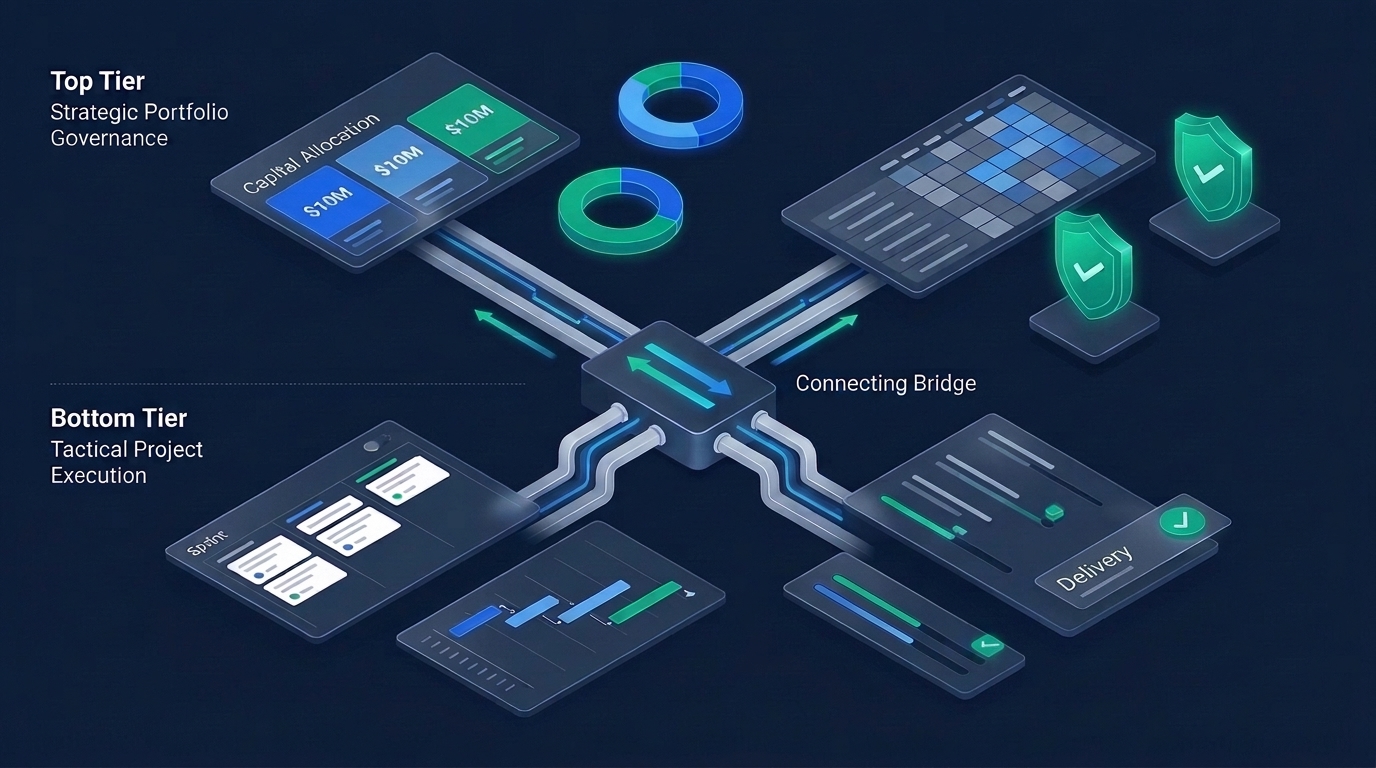
Project portfolio management (PPM) software is an enterprise investment governance system that aligns aggregate capital expenditures, operational resources, and strategic programs across an entire enterprise. PPM software operates by ingesting cross-program financial actuals, stage-gate deliverables, and macro capacity limits, producing predictive scenario simulations, investment ranking matrices, and executive audit controls. The architectural focus of PPM software is the strategic portfolio entity, governing multi-project risk distribution and return on capital investment under PMI Standard for Portfolio Management guidelines.
Project management (PM) software is an operational work execution platform that tracks discrete tasks, assignees, deadlines, and technical dependencies within an individual approved initiative. PM software operates by decomposing project scope into work breakdown structures (WBS), calculating critical path schedules, and surfacing daily velocity metrics for delivery teams. The architectural focus of PM software is the operational work unit, governing schedule adherence and output completion for tactical project teams.
The boundary between the two systems reflects the difference between doing the right work (portfolio governance) and doing the work right (project delivery).
Core Comparison Matrix: PPM vs. Project Management
| Architectural Dimension | Project Management (PM) | Project Portfolio Management (PPM) | Enterprise Governance Impact |
|---|---|---|---|
| Primary System Entity | Task, subtask, sprint, milestone | Program, portfolio, investment line, resource pool | Strategic alignment across business units |
| User Hierarchy | Project managers, engineers, individual contributors | PMO directors, enterprise architects, CFO, CIO | Executive decision-making vs. daily task execution |
| Financial Accounting | Burn hours, task expense logging | CapEx vs. OpEx capitalization (FASB ASC 350-40) | Multi-million dollar tax compliance and R&D amortization |
| Resource Governance | Individual calendar availability, assigned tasks | Aggregate role-based capacity modeling, hiring forecasts | Resolving cross-project resource bottlenecks |
| Risk Modeling | Task-level blocker logs, issue registers | Monte Carlo portfolio risk simulation (NIST SP 800-160) | Mitigating catastrophic systemic portfolio failure |
| Stage-Gate Gates | Task completion status (Done / In Progress) | Formal funding phase gates (Go / No-Go / Kill) | Terminating underperforming initiatives before capital waste |
| Reporting Horizon | Daily standups, weekly sprint burndown | Multi-year capital plans, annual investment cycles | Long-term return on invested capital (ROIC) |
Data Schema Divergence: Task Entities vs. Portfolio Entities
Data architecture in project management systems is relational and task-centric. A standard PM database schema links user records to task records, task records to parent milestones, and milestones to a single project container. Query structures optimize for rapid read/write operations on individual status flags, comment threads, and localized Gantt chart dependencies. This architecture scales horizontally across thousands of daily updates but collapses when queried for cross-initiative capital modeling or multi-departmental role constraints.
graph LR
    subgraph OperationalLayer["Operational PM Layer (Task-Centric)"]
        T1["Task A1: Schema Design"] --> M1["Milestone: DB Setup"]
        T2["Task A2: API Endpoint"] --> M1
        M1 --> P1["Project Alpha"]
    end

    subgraph GovernanceLayer["Strategic PPM Layer (Investment-Centric)"]
        P1 --> Prog1["Program: Digital Transformation"]
        P2["Project Beta"] --> Prog1
        Prog1 --> Port1["Strategic Portfolio: Core Modernization"]
        Cap["Capital Budget ($10M)"] --> Port1
        Res["Global Resource Pool (500 FTEs)"] --> Port1
    end
Data architecture in project portfolio management platforms is dimensional and investment-centric. A PPM schema models strategic objectives as parent entities, mapping capital programs, product lines, and funding tranches into a directed investment graph. Individual projects exist within the database not as standalone work boards, but as cost-consuming nodes bound to multi-year fiscal calendars and global resource pools. This dimensional modeling allows the system to recalculate portfolio-wide impact instantly when a corporate priority shifts or an annual budget is adjusted.
Financial Governance & CapEx Capitalization (FASB ASC 350-40)
Software capitalization tracking is an enterprise financial discipline that classifies labor costs as either amortizable capital expenditures (CapEx) or immediate operational expenses (OpEx). Enterprise PPM platforms enforce capitalization rules by mapping employee time-tracking directly to specific project lifecycle phases under FASB ASC 350-40 (Internal-Use Software) guidelines. The platform separates preliminary project phases (expensed as OpEx) from application development stages (capitalized as CapEx), generating auditable accounting ledgers for the finance team.
Standard project management tools lack compliant financial governance engines. While a PM tool can record hours spent on a user story, it cannot automatically apply capitalization criteria, reconcile contractor rate cards against purchase orders, or split amortizable development work from ongoing maintenance. Organizations attempting to govern multi-million dollar IT capital programs inside basic PM tools face substantial audit risk and manual reconciliation overhead during annual corporate audits.
Capacity Planning: Task Assignment vs. Scenario-Based Modeling
Resource capacity planning in project management software operates on simple task allocation. A project lead assigns a developer or designer to a 40-hour task, and the tool evaluates whether that individual's calendar shows available working hours in that sprint. This localized scheduling model assumes that resource demand is isolated and that team members operate inside a single project boundary.
Resource capacity management in enterprise PPM operates on macro scenario modeling under ISO 21504:2015. The PPM platform aggregates enterprise-wide demand across dozens of concurrent initiatives and compares it against finite departmental skill pools. If an executive proposes advancing a major product release by three months, the PPM simulation engine calculates the exact resource deficit across every other active project, identifies critical path bottlenecks, and models the hiring or contractor spend required to execute the shift without crashing parallel initiatives.
The Two-Tier Tooling Architecture
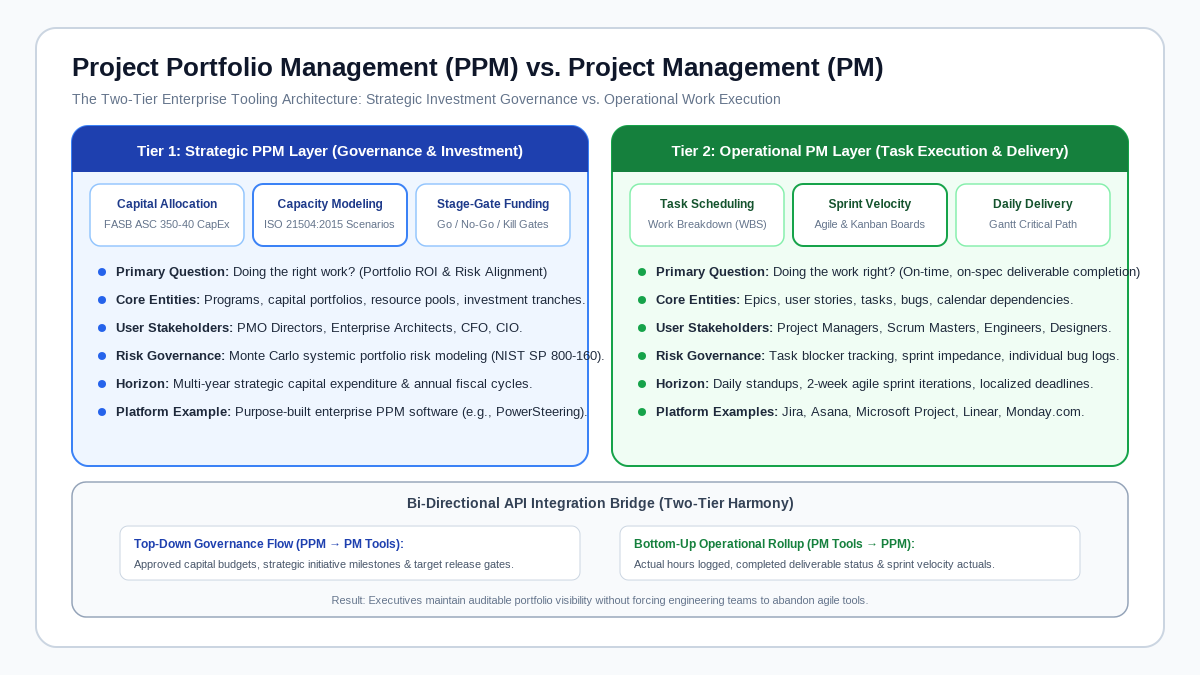
Enterprise organizations frequently make the mistake of attempting to force every team into a single software tool. When an enterprise replaces all operational PM software with an enterprise PPM platform, software engineering and creative teams experience significant operational friction due to heavy governance overhead. Conversely, when leadership attempts to manage a $50M capital portfolio using standard task boards, executive visibility disintegrates into fragmented spreadsheets.
graph TD
    Exec["Executive Leadership & CFO"] -->|Capital Allocation & Strategic Priorities| PPM["Enterprise PPM Governance Layer<br/>(e.g., PowerSteering)"]
    PMO["Enterprise PMO & Governance Board"] -->|Stage-Gate Audits & Capacity Modeling| PPM

    PPM -->|Bi-Directional API Integration| Sync["Portfolio Data Exchange API"]

    Sync -->|Work Packages & Budget Tranches| Team1["Software Engineering (Jira / Agile)"]
    Sync -->|Marketing Initiatives & Deliverables| Team2["Marketing & Ops (Asana / Trello)"]
    Sync -->|Operations & Delivery Milestones| Team3["Operations & Delivery Teams (Kanban / Agile)"]

    Team1 -->|Actual Hours & Stage Milestones| Sync
    Team2 -->|Project Status & Deliverables| Sync
    Team3 -->|Schedule Progress & Actuals| Sync
The industry standard pattern is a Two-Tier Architecture:
- Tier 1 (Strategic Governance): An enterprise PPM platform sits at the enterprise PMO level, serving as the single source of truth for capital budgets, stage-gate approvals, strategic KPIs, and cross-enterprise resource allocation.
- Tier 2 (Operational Execution): Decentralized project management tools operate at the team level, allowing individual groups to use specialized agile, sprint, or Kanban workflows tailored to their daily delivery habits.
- The Integration Bridge: Bi-directional APIs synchronize completed milestones, actual hours, and delivery status back into the PPM system, giving leadership live financial and portfolio visibility without disrupting frontline team velocity.
Buyer Decision Framework: When Do You Outgrow PM Software?
An organization reaches the operational threshold requiring dedicated PPM software when project failure is caused by cross-initiative contention rather than task-level execution. Specific enterprise triggers include:
- Resource Contention Across Multiple Programs: Teams are constantly blocked because critical specialists (enterprise architects, security auditors, database administrators) are over-allocated across five competing projects simultaneously.
- Capital Budget Visibility Gaps: Finance cannot determine how much internal labor cost was invested in capitalized software development versus ongoing maintenance without manual spreadsheet audits.
- Strategic Misalignment: Executive leadership discovers that 30% of active engineering hours are absorbed by low-priority legacy maintenance while strategic Tier-1 initiatives miss release dates.
- Stage-Gate Governance Breakdown: Projects continue consuming monthly budget long after their business case has dissolved because no centralized governance gate forces a formal continuation review.
For enterprise buyers managing complex multi-project portfolios, explore our independent PowerSteering review and benchmark top enterprise platforms in our best project portfolio management software guide.
What is the fundamental difference between PPM and project management?
Project management focuses on tactical execution for a single project (tasks, assignees, deadlines, and critical path delivery). Project portfolio management (PPM) operates at the executive governance layer, evaluating all active projects as an investment portfolio to optimize capital allocation, resource capacity, and strategic business alignment.
Can an enterprise use project management software instead of PPM?
Small organizations and single-team environments can operate effectively with project management software alone. However, once an organization manages more than 20 to 30 concurrent projects, standard PM tools cannot resolve cross-project resource bottlenecks, automate CapEx/OpEx software capitalization under FASB ASC 350-40, or model portfolio-wide risk.
How does PPM software integrate with existing team project management tools?
Enterprise PPM platforms deploy bi-directional API connectors to operational tools like Jira, Trello, and Asana. This two-tier architecture allows frontline teams to manage daily tasks in their preferred execution tool while milestone status, actual labor hours, and delivery metrics roll up automatically into the executive PPM system.
What is stage-gate governance in a PPM platform?
Stage-gate governance is a formal capital management framework where a project must pass predetermined evaluation gates (such as feasibility review, business case validation, and architectural review) before unlocking its next funding tranche, preventing organizational capital waste on unviable initiatives.