TL;DR
RFP evaluation criteria and scoring (procurement decision frameworks) provide structured numerical weighting and compliance validation beyond subjective vendor impressions. Without mathematical scoring rubrics, enterprise buying committees default to brand familiarity, misleading sales demos, and pricing models that conceal long-term maintenance overhead. This guide explains how to construct weighted evaluation matrices, isolate mandatory pass/fail compliance gates, normalize divergent licensing structures, and arbitrate scoring variance across multi-stakeholder evaluation panels.
Enterprise RFP Evaluation & Scoring: 10-Point Readiness Audit
The interactive checklist below establishes whether your procurement evaluation framework satisfies enterprise auditability, legal compliance, and mathematical scoring standards before vendor packets are distributed to committee reviewers.
What is RFP Evaluation Criteria and Scoring?

RFP evaluation criteria and scoring is an enterprise procurement methodology that transforms qualitative vendor responses into quantifiable decision matrices through predefined weights and compliance gates. The methodology operates by assigning percentage multipliers to discrete evaluation categories—such as functional architecture, data security, total cost of ownership, and implementation viability—producing normalized composite scores across all participating bidders. The mathematical rigor of RFP evaluation scoring is parameterized by the weighted sum model (Score = SUM [ Weight * Raw Score ]), governing vendor shortlisting and mitigating post-award protest risks.
Modern software acquisitions require cross-functional consensus among IT security, legal, procurement, and frontline operational business units. When organizations evaluate complex platforms—such as enterprise proposal software, cloud infrastructure, or enterprise resource planning suites—relying on unweighted grading leads to catastrophic misalignments. A vendor offering exceptional user interface polish might fail critical regulatory controls, while a vendor with superior compliance postures might submit a punitive fee structure. Formal evaluation criteria enforce objective trade-offs, ensuring every proposal is judged against identical, pre-published organizational priorities.
This procedural discipline complements the nine-section software RFP authoring sequence and the vendor-side operational mechanics detailed in our proposal software architectural guide.
The Four Core Pillars of Proposal Evaluation
Enterprise buying committees evaluate proposals across four fundamental dimensions, each requiring distinct evaluation rubrics, reviewer credentials, and scoring scales.
1. Functional and Architectural Requirements
Functional evaluation determines whether the proposed platform executes the specific operational workflows required by end users. Rather than assessing features as isolated capabilities, evaluation teams group requirements into operational user journeys: content authoring, repository governance, automated document assembly, CRM synchronization, and reporting analytics. Evaluators grade functional fit using a standardized 1-to-5 Likert scale, where a score of 5 represents native, out-of-the-box automation, a 3 indicates third-party integration or custom scripting, and a 1 signals an unverified roadmap promise.
Architectural vetting examines underlying system design, database scalability, multi-tenant isolation, API throughput quotas, and connector latency. Enterprise buyers must verify whether integration endpoints support bidirectional synchronization or rely on batch polling cycles that delay operational reporting.
2. Information Security and Regulatory Compliance
Security evaluation assesses vendor posture against established cybersecurity frameworks, including NIST SP 800-53, ISO/IEC 27001, and SOC 2 Type II controls. For regulated acquisitions—such as defense procurement governed by FAR/DFARS standards (detailed in our government contracting guide) or healthcare environments under HIPAA—security controls operate as mandatory prerequisites rather than negotiable scoring items.
Evaluators inspect raw audit attestations rather than vendor trust portal summaries. Key verification checkpoints include encryption protocols (AES-256 for data at rest, TLS 1.3 in transit), federated single sign-on (SAML 2.0/OIDC), role-based access granularity, vulnerability disclosure cadences, and continuous penetration testing reports conducted by accredited third-party assessors.
3. Total Cost of Ownership (TCO) and Commercial Viability
Commercial evaluation calculates the complete five-year financial commitment of software adoption, extending beyond initial subscription licensing. Procurement teams normalize proposals by compiling software licensing tiers, implementation consulting fees, data migration charges, custom connector maintenance, premium support packages, and required internal FTE allocation for ongoing system governance.
Vendor corporate viability examines balance sheet stability, debt ratios, customer churn metrics, and R&D reinvestment velocity. A vendor offering aggressive discounting but experiencing high executive turnover or dwindling engineering investments introduces severe supply-chain operational risk.
4. Implementation Methodology and Vendor SLA Commitments
Implementation evaluation reviews the proposed deployment roadmap, resource commitments, and contractual service level agreements (SLAs). Evaluators analyze the vendor's 30/60/90-day onboarding milestones, dedicated customer success architectures, training delivery models, and historical reference implementations of comparable organizational scale.
Contractual SLAs must specify availability guarantees (such as 99.9% uptime excluding scheduled maintenance), financial penalty rebates for service outages, incident response windows categorized by severity level, and data recovery point objectives (RPO $\le 1$ hour) and recovery time objectives (RTO $\le 4$ hours).
Constructing the Scoring Model: Weighted Sum vs Gatekeeper
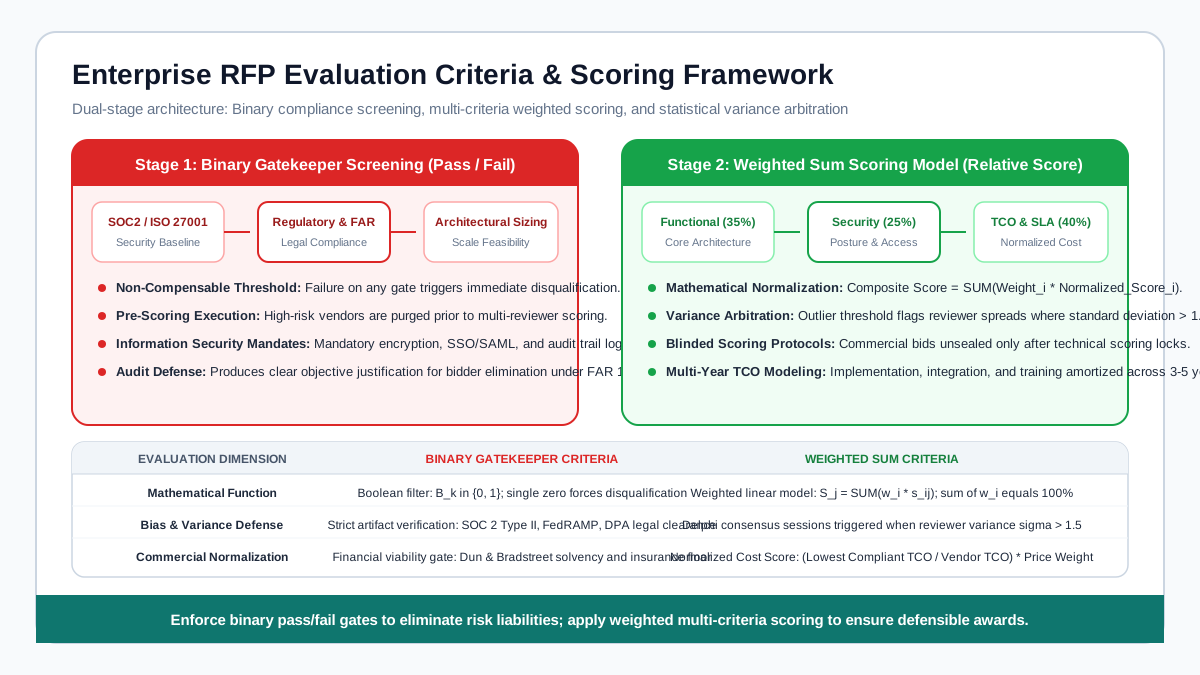
An effective procurement scoring model combines two mathematical architectures: non-negotiable binary gatekeeper filters and a multi-criteria weighted sum model.
Weighting Framework: Mathematical Normalization and Category Multipliers
A weighting framework is an analytical formula that distributes 100 percentage points across RFP evaluation categories according to organizational priority. The framework operates by multiplying raw evaluator scores (typically on a 1-to-5 or 1-to-10 scale) by each section's decimal weight, producing a weighted category subtotal that prevents secondary features from overshadowing core requirements. The standard distribution for enterprise software RFPs allocates 30–40% to functional requirements, 20–25% to security and architecture, 20–25% to total cost of ownership, and 15–20% to vendor viability and implementation SLAs.
The table below illustrates a standard 100-point enterprise weighting allocation model:
| Evaluation Dimension | Standard Weight | Evaluation Focus | Primary Reviewer Role |
|---|---|---|---|
| Compliance Gatekeeper | Pass / Fail | SOC 2 Type II, SSO, Data Sovereignty, Legal Terms | InfoSec & Legal Counsel |
| Functional Fit | 35% | Workflow automation, repository search, authoring UX | End-User Committee / Bid Ops |
| Security & Architecture | 20% | API scalability, tenant isolation, encryption | Enterprise Architect / CISO |
| Total Cost of Ownership | 25% | 5-year licensing, setup fees, internal FTE governance | Procurement / Finance |
| Implementation & SLAs | 20% | Rollout milestones, training, 99.9% uptime SLA | Project Manager / IT Operations |
In this model, raw category scores ($r \in [1, 5]$) are normalized to a 100-point index using the formula $S_i = (r_i / 5) \times W_i$, where $W_i$ represents the category weight. The final composite score represents the sum of all weighted subtotals:
S_total = SUM [ (r_i / r_max) * W_i ]
Compliance Gatekeeper: Binary Pass/Fail Security and Legal Screening
Binary pass/fail gatekeeper criteria are non-negotiable procurement prerequisites that disqualify non-compliant vendor proposals prior to qualitative scoring. The gatekeeper operates by validating mandatory security attestations, legal terms, and operational certifications—including SOC 2 Type II reports, SSO compatibility, data residency guarantees, and regulatory BAAs—excluding failing vendors before technical committees expend evaluation hours. The binary nature of gatekeeper criteria enforces a strict zero-tolerance threshold, ensuring that commercial pricing advantages cannot compensate for fundamental compliance vulnerabilities.
When a vendor fails a mandatory gatekeeper requirement (for example, failing to provide audited data isolation or refusing standard indemnity obligations), their proposal is marked disqualified and excluded from subsequent weighted scoring passes.
Reviewer Governance: Mitigating Variance and Bias
Multi-stakeholder evaluation panels introduce subjective biases and divergent scoring behaviors. Left unchecked, aggressive graders can artificially depress a vendor's standing, while lenient reviewers can elevate weaker offerings.
Consensus Arbitration: Standard Deviation Tracking and Reviewer Scoring Variance
Reviewer variance arbitration is a statistical quality control procedure that flags divergent evaluator scores across multi-member RFP panels. The process operates by calculating the mean score ($\mu$) and standard deviation ($\sigma$) across all reviewers for each individual requirement. When an evaluator's score deviates by more than 1.5 standard deviations ($\sigma > 1.5$) from the committee mean, the divergence triggers a mandatory consensus meeting.
During consensus arbitration, the committee employs a modified Delphi method: evaluators explain the technical reasoning behind outlier scores, review vendor source text, and reconcile interpretations before finalizing scores. This prevents individual bias from distorting the composite procurement outcome.
Blinded Scoring Protocols
To preserve impartiality, enterprise procurement offices implement blinded scoring protocols. Technical and operational reviewers evaluate functional architecture, system integration, and usability responses without visibility into vendor commercial pricing, discounting tiers, or contractual fee proposals.
Simultaneously, the procurement team evaluates financial bids independently. Only after technical and security scoring is locked and signed does the committee combine the weighted functional scores with the normalized cost calculations, eliminating the subconscious bias that occurs when reviewers know which vendor is cheaper.
Normalizing Vendor Pricing Across Variable Models
Comparing software pricing across multiple bidders is notoriously difficult due to divergent packaging strategies. One vendor might quote per-seat subscription licenses with unlimited document generation, while another charges a low base platform fee paired with consumption-based metering for API calls, template exports, or storage.
TCO Normalization: Multi-Year Cost Modeling Beyond Base Licensing Fees
Total cost of ownership normalization is a financial modeling procedure that converts disparate vendor fee structures into a standardized five-year net present value schedule. The methodology operates by aggregating all direct and indirect capital expenditures: subscription tiers, user license volume scaling, implementation professional services, data migration consulting, premium customer success retainers, and internal employee maintenance hours.
Procurement committees normalize these figures by establishing a standard baseline usage model (e.g., 250 active contributors, 1,000 read-only consumers, 5,000 generated documents per quarter). Evaluators score financial proposals inversely proportional to total cost, using the standard relative pricing formula:
Financial Score = (Lowest Compliant Bid / Vendor Bid Under Evaluation) * Commercial Weight
Under this model, the lowest verified total-cost proposal receives the full commercial score (e.g., 25 points), while higher-cost bids receive scaled deductions proportional to their price premium. Buyers evaluating enterprise proposal systems can review our RFP vendor scoring rubric and use the TCO calculator for proposal software to model multi-year expenditure curves.
Audit Governance and Bid Protest Defense
In regulated corporate and public-sector procurement, decisions are subject to formal internal compliance audits and external bidder protests. Disappointed vendors frequently challenge award determinations by alleging subjective favoritism, undisclosed evaluation criteria, or inconsistent scoring.
Audit Governance: Protest Mitigation and Objective Scoring Trails
Procurement audit governance is a compliance framework that preserves evidentiary audit logs, scoring rubrics, and reviewer commentary to defend contract award decisions against administrative protests. The framework operates by archiving timestamped evaluator scoring sheets, consensus arbitration minutes, and explicit cross-references linking every assigned score directly to verified vendor RFP responses.
To ensure protest-proof defensibility, procurement committees must enforce three operational rules:
- Never alter published weights post-issuance: Applying weights different from those published in the original RFP constitutes an automatic protest violation.
- Require written justification for extreme scores: Any score of 1 (poor) or 5 (exceptional) must be accompanied by written operational justifications referencing specific proposal passages.
- Preserve pre-consensus individual scorecards: Audit trails must document the progression from initial individual evaluation to arbitrated consensus, proving that deliberations were objective, collaborative, and evidence-led.
Organizations deploying mature proposal automation—such as Upland Qvidian—leverage built-in compliance matrices and audit-ready content repositories to streamline the authoring and review lifecycle while preserving absolute traceability across complex bid submissions.
How do enterprise committees calculate weighted RFP scores across disparate vendor proposals?
Enterprise committees calculate weighted scores by multiplying raw section grades (typically scored 1 to 5) by predefined percentage multipliers that sum to 100%. Raw scores are normalized against the maximum possible score and multiplied by the category weight, producing a standardized composite score between 0 and 100. This ensures that high-priority dimensions like functional capability and data security drive the award decision rather than minor secondary features.
What is the difference between mandatory pass/fail criteria and weighted scoring factors in an RFP?
Mandatory pass/fail criteria are binary gatekeepers that vendors must satisfy completely to be considered, such as SOC 2 Type II certification, SAML SSO integration, or required regulatory compliance. If a vendor fails a mandatory requirement, their proposal is disqualified immediately. Weighted scoring factors, by contrast, are qualitative attributes (such as user interface ergonomics, workflow automation depth, and implementation timelines) where vendors receive comparative numerical scores that compound into a composite ranking.
How do evaluation teams normalize variable vendor pricing models in a proposal matrix?
Evaluation teams normalize pricing by modeling a standardized five-year Total Cost of Ownership (TCO) that incorporates base licensing, per-user seat fees, usage-based consumption tiers, implementation professional services, data migration costs, and required internal FTE maintenance overhead. The lowest compliant TCO bid receives the maximum available commercial points, and competing bids receive scaled points inversely proportional to their cost variance relative to the lowest bidder.
How do evaluation committees resolve wide scoring discrepancies between technical and business reviewers?
Committees resolve scoring discrepancies by tracking standard deviation across reviewer sheets and triggering consensus arbitration whenever an individual evaluator's score deviates by more than 1.5 standard deviations from the group mean. During arbitration, reviewers use a modified Delphi method to review vendor source text, reconcile differing technical interpretations, and reach an evidence-grounded consensus score before finalizing results.
What documentation is required to defend an RFP vendor selection against bidder protests?
Defending an award decision requires a complete, immutable audit trail consisting of the published RFP weighting schedule, timestamped individual evaluator scorecards, written operational rationales for outlier scores, minutes from consensus arbitration meetings, and normalized financial calculation sheets. Maintaining objective traceability from vendor response text to final scoring sheets proves that the selection process followed published evaluation standards without subjective bias or procedural irregularities.
Related Reviews · RFP and Proposal Automation Cluster
Our analyst-authored reviews evaluate enterprise proposal automation platforms against the 10-criteria scoring framework:
- Upland Qvidian Review, enterprise RFP response governance and multi-reviewer workflow depth (9.0/10)
- PandaDoc Review, SMB proposal authoring and e-signature execution (8.4/10)
- DocuSign CLM Review, contract lifecycle management and post-award agreement workflows (8.6/10)
Buying Guides
- Best RFP Software Platforms in 2026, comprehensive category roundup and comparison matrix
- How to Write a Software RFP in 2026, step-by-step nine-section authoring guide
- RFP Software for Government Contracting, FAR/DFARS compliance and FedRAMP bid governance
Vendor Comparisons
- Qvidian vs PandaDoc, enterprise RFP response depth versus outbound proposal automation
Buyer Toolkit
- Vendor Scoring Rubric, 10-criteria weighted framework for RFP evaluation
- RFP Template for Enterprise Software, 9-section customizable procurement template
- TCO Calculator for Proposal Software, 5-year financial modeling tool